
Triera Metals

Understanding the Manufacturing Process of Brass Automotive Components
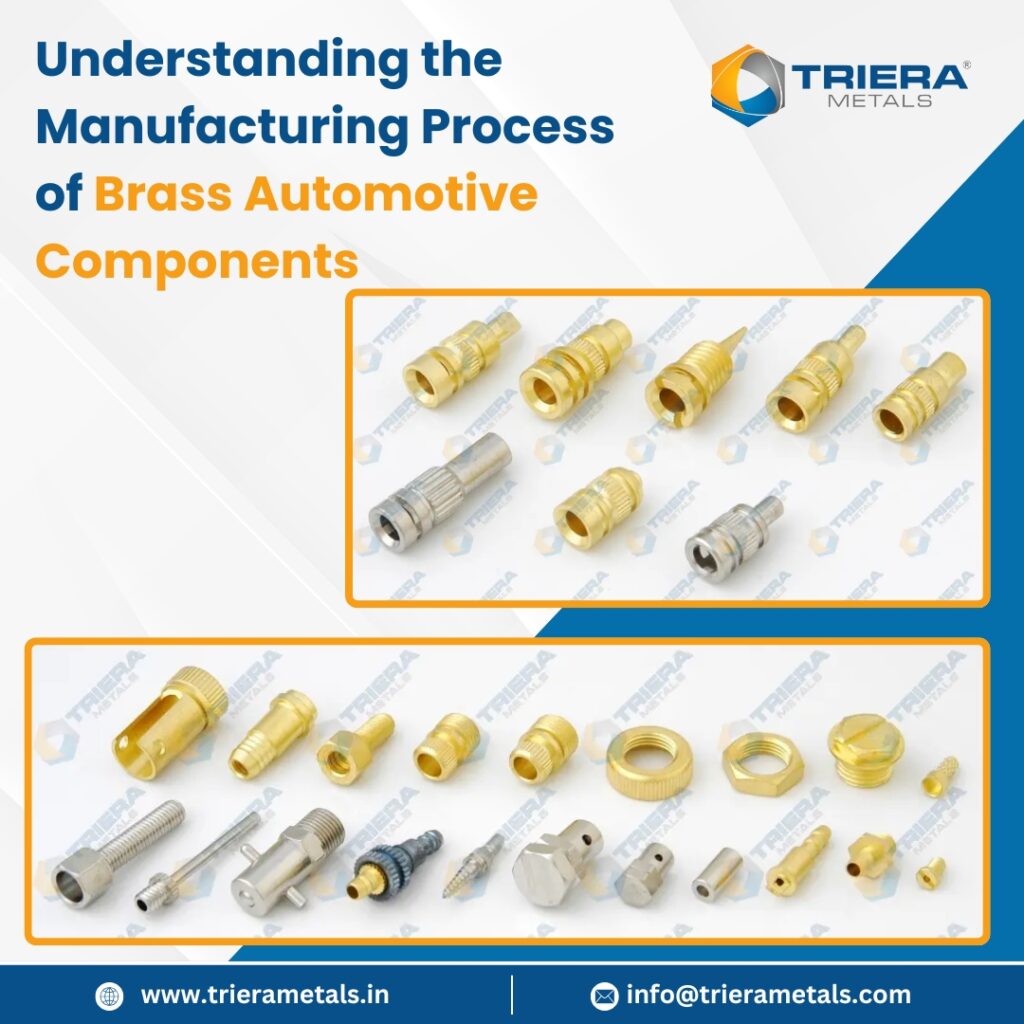
Brass Automotive Components
Brass Automotive Components play a vital role in the performance, reliability, and efficiency of modern vehicles. Known for their durability, corrosion resistance, and superior machinability, brass parts are used extensively in critical systems like fuel delivery, electrical circuits, braking, and cooling. Understanding the manufacturing process behind these components helps highlight why brass continues to be a preferred material in the automotive industry.

Why Brass is Preferred in the Automotive Industry

Brass is a copper-zinc alloy that offers an ideal balance between strength and workability. Its natural resistance to corrosion ensures long-lasting performance, even in challenging environments such as high humidity or exposure to fuel and oil. In addition, brass’s excellent electrical conductivity makes it perfect for electrical connectors and terminals in vehicles. The material’s ease of machining also allows manufacturers to produce precise components efficiently, keeping production costs under control.

Types of Brass Used in Automotive Manufacturing

Depending on the application, different brass alloys are used:

  • Free-Cutting Brass: Best suited for high-speed machining and intricate designs.
  • High Tensile Brass: Offers superior strength and is used in components that endure mechanical stress.
  • Naval Brass: Resistant to corrosion and wear, making it suitable for parts exposed to moisture or chemicals.

Each alloy is chosen based on the specific requirements of the automotive system in which it will function.

Applications of Brass Automotive Components

Brass components are integral to various vehicle systems, including:

  • Fuel Systems: Valves, adapters, and fittings that require tight sealing and corrosion resistance.
  • Electrical Systems: Connectors, terminals, and switches that benefit from brass’s conductivity.
  • Braking Systems: Hydraulic connectors and pressure fittings.
  • Cooling Systems: Radiator components and water connectors.

These applications demonstrate the versatility and reliability of brass across multiple automotive functions.

Step-by-Step Manufacturing Processy

The production of Brass Automotive Components involves several precise and controlled steps to ensure quality and consistency.

1. Raw Material Selection

The process begins with selecting high-grade copper and zinc in exact ratios. Sometimes, trace elements like lead or tin are added to enhance machinability. Maintaining purity at this stage is crucial for achieving consistent mechanical and chemical properties.

2. Melting and Alloying

The selected metals are melted in furnaces under controlled temperatures. Alloying elements are added to improve desired properties. Continuous stirring ensures even distribution of all materials, resulting in a uniform and strong brass alloy.

3. Casting Process

The molten alloy is poured into molds to form billets or rods.

  • Sand Casting is used for larger, complex parts.
  • Die Casting is ideal for producing high-volume, precise components.

This stage shapes the foundation for further forming and machining processes.

4. Forging and Forming

After casting, the brass billets are reheated and hot forged or cold worked to refine the shape. Forging improves the internal grain structure of the metal, enhancing strength and durability. Cold forming allows for dimensional accuracy and smoother finishes.

5. Machining Operations

Machining is a crucial stage in producing precise Brass Automotive Components.Advanced CNC machines perform operations such as turning, milling, drilling, and threading to meet tight tolerances. This ensures that each part fits perfectly within the assembly it is designed for

6. Surface Finishing

The components undergo several finishing processes, including deburring, polishing, and electroplating. Finishing not only enhances the aesthetic appeal but also provides an additional protective layer against corrosion, extending the lifespan of the part.

7. Quality Inspection and Testing

Before dispatch, every brass component undergoes detailed quality inspection.

  • Dimensional checks ensure accurate sizes and tolerances.
  • Mechanical testing verifies strength and hardness.
  • Corrosion and leakage tests confirm long-term reliability under operating conditions.

This thorough testing guarantees that only defect-free components reach the end customer.

Sustainability in Brass Manufacturing

One of the biggest advantages of using brass is its recyclability. Nearly all brass scrap generated during production can be melted and reused without losing quality. This makes brass an eco-friendly choice for manufacturers looking to reduce waste and energy consumption. Additionally, advancements in furnace technology have improved melting efficiency, reducing emissions and production costs.

Challenges in Brass Component Production

While brass is highly versatile, its production process comes with challenges.

Maintaining a consistent alloy composition is critical to prevent variations in mechanical properties. Machining brass also generates fine chips that require proper recycling management. Manufacturers continue to adopt innovative machining techniques and waste control systems to enhance productivity while maintaining sustainability.

Conclusion

The manufacturing process of Brass Automotive Components is a fine blend of material science, precision engineering, and sustainable practices. From selecting raw materials to final quality checks, every stage is carefully managed to deliver components that meet the demanding standards of the automotive sector. With properties like durability, corrosion resistance, and excellent machinability, brass continues to prove its value as a reliable and efficient material for automotive applications. As technology advances, the use of brass in vehicles will likely expand further, supporting performance and longevity in modern transportation systems.
Scroll to Top